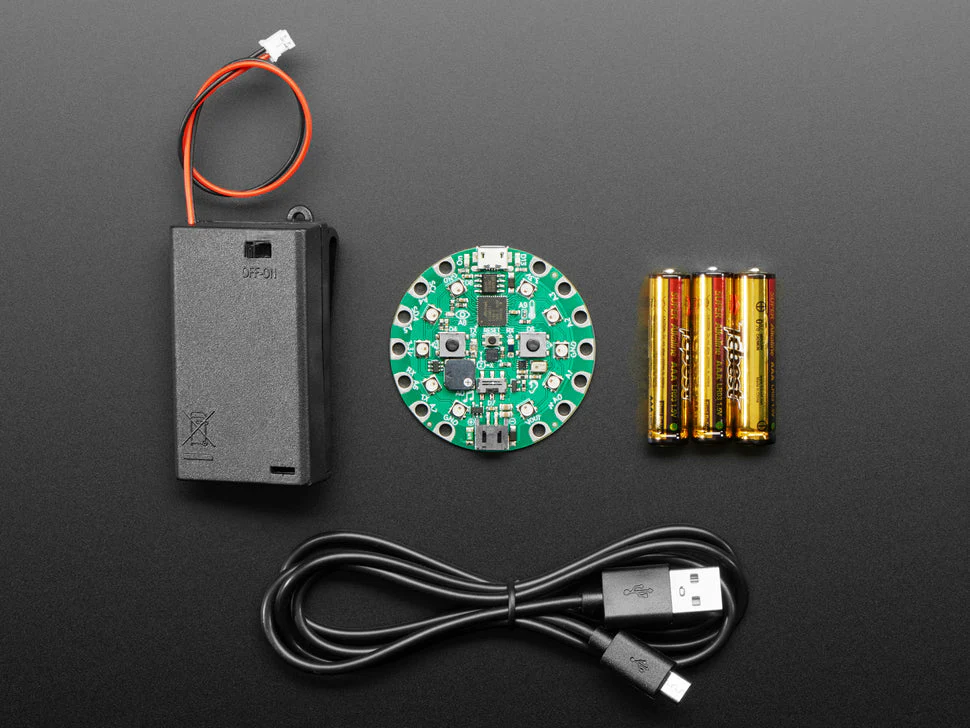
4-H Circuit Playground Express - Base Kit
The 4-H Circuit Playground Express Base Kit provides everything you need to get started with the Circuit Playground Express — a beginner-friendly development board packed with sensors, LEDs, and multiple programming options. Program it with Microsoft MakeCode (block-based or JavaScript), code.org CS Discoveries, CircuitPython, or Arduino IDE.
The Circuit Playground Express features an ATSAMD21 ARM Cortex M0 processor running at 48MHz with 2MB of SPI flash storage. Its round PCB includes 10 NeoPixels, multiple sensors, a mini speaker, buttons, and 8 alligator-clip friendly I/O pads — all ready to use without soldering.
Kit Contents
- 1× 4-H Circuit Playground Express
- 1× USB cable (A to Micro-B, 3ft)
- 3× Alkaline AAA batteries
- 1× 3×AAA battery holder with on/off switch, JST connector, and belt clip
- 1× Mini storage box
Circuit Playground Express Features
- 10× Mini NeoPixels – Individually addressable RGB LEDs
- Motion Sensor – LIS3DH triple-axis accelerometer with tap and free-fall detection
- Temperature Sensor – Onboard thermistor
- Light Sensor – Phototransistor (also works as colour and pulse sensor)
- Sound Sensor – MEMS microphone
- Mini Speaker – 7.5mm magnetic speaker with class D amplifier
- IR Transceiver – Infrared receiver and transmitter for remote control codes, inter-board messaging, and proximity sensing
- 2× Push Buttons – Labelled A and B
- 1× Slide Switch
- 8× Alligator-Clip Friendly Pads – With I2C, UART, analogue inputs, PWM output, and capacitive touch
- 1× True Analogue Output
Specifications
- Processor – ATSAMD21 ARM Cortex M0, 48MHz, 3.3V
- Storage – 2MB SPI flash (for CircuitPython code and libraries)
- USB – Micro-USB for programming, debugging, and HID emulation (keyboard, mouse, joystick, MIDI)
- Programming – Microsoft MakeCode, code.org CS Discoveries, CircuitPython, Arduino IDE
Ideal For
- 4-H STEM programmes and classroom activities
- Beginner electronics and coding education
- Interactive wearable projects
- Sensor-based experiments
Product Information
Product Information
Shipping & Returns
Shipping & Returns
Description
The 4-H Circuit Playground Express Base Kit provides everything you need to get started with the Circuit Playground Express — a beginner-friendly development board packed with sensors, LEDs, and multiple programming options. Program it with Microsoft MakeCode (block-based or JavaScript), code.org CS Discoveries, CircuitPython, or Arduino IDE.
The Circuit Playground Express features an ATSAMD21 ARM Cortex M0 processor running at 48MHz with 2MB of SPI flash storage. Its round PCB includes 10 NeoPixels, multiple sensors, a mini speaker, buttons, and 8 alligator-clip friendly I/O pads — all ready to use without soldering.
Kit Contents
- 1× 4-H Circuit Playground Express
- 1× USB cable (A to Micro-B, 3ft)
- 3× Alkaline AAA batteries
- 1× 3×AAA battery holder with on/off switch, JST connector, and belt clip
- 1× Mini storage box
Circuit Playground Express Features
- 10× Mini NeoPixels – Individually addressable RGB LEDs
- Motion Sensor – LIS3DH triple-axis accelerometer with tap and free-fall detection
- Temperature Sensor – Onboard thermistor
- Light Sensor – Phototransistor (also works as colour and pulse sensor)
- Sound Sensor – MEMS microphone
- Mini Speaker – 7.5mm magnetic speaker with class D amplifier
- IR Transceiver – Infrared receiver and transmitter for remote control codes, inter-board messaging, and proximity sensing
- 2× Push Buttons – Labelled A and B
- 1× Slide Switch
- 8× Alligator-Clip Friendly Pads – With I2C, UART, analogue inputs, PWM output, and capacitive touch
- 1× True Analogue Output
Specifications
- Processor – ATSAMD21 ARM Cortex M0, 48MHz, 3.3V
- Storage – 2MB SPI flash (for CircuitPython code and libraries)
- USB – Micro-USB for programming, debugging, and HID emulation (keyboard, mouse, joystick, MIDI)
- Programming – Microsoft MakeCode, code.org CS Discoveries, CircuitPython, Arduino IDE
Ideal For
- 4-H STEM programmes and classroom activities
- Beginner electronics and coding education
- Interactive wearable projects
- Sensor-based experiments