Adafruit Feather RP2350
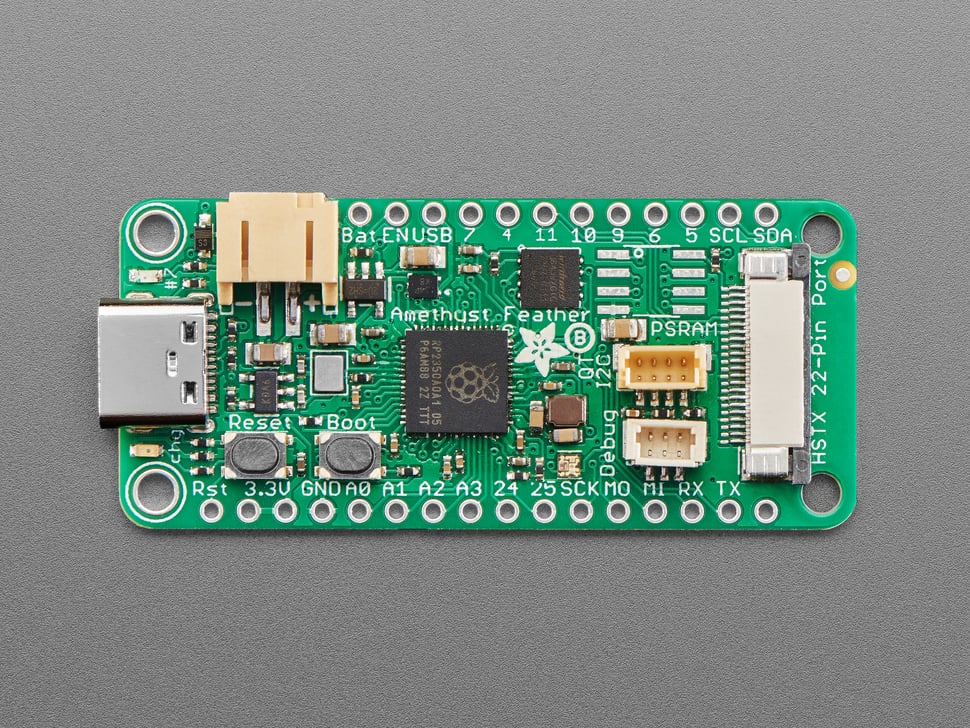
The Adafruit Feather RP2350 brings the powerful RP2350 microcontroller to the classic Feather form factor, giving you full compatibility with the entire FeatherWing ecosystem. With dual Cortex-M33 cores running at 150 MHz, 520 KB of SRAM, and 8 MB of flash, this board delivers roughly twice the performance of RP2040-based Feathers.
The RP2350 is a significant upgrade over its predecessor — the M33 cores include hardware floating-point support, there are three PIO blocks (12 state machines total instead of 8), TrustZone secure boot, and a High Speed Transmit (HSTX) peripheral for driving differential data such as DVI output without overclocking or consuming PIO resources. An unpopulated SOIC PSRAM footpad with chip select on GPIO 8 lets you add external PSRAM if needed.
Key Features
- RP2350 Dual Cortex-M33 – 150 MHz with FPU (also supports dual RISC-V cores), 520 KB SRAM, 8 KB OTP
- 8 MB QSPI Flash – Stores firmware and CircuitPython/MicroPython code and files (~7 MB usable with Python)
- 29 GPIO Pins – 21 on Feather headers, 8 on the 22-pin HSTX connector (usable as general GPIO too)
- Four 12-bit ADCs – One more analogue input than Pico 2
- 24 PWM Channels – For servos, LEDs, motor control, and more
- 12 PIO State Machines – Three PIO blocks for custom peripherals and protocols
- USB Type C – Built-in ROM UF2 bootloader and serial port debugging
- STEMMA QT / Qwiic Connector – Plug-and-play I2C sensor connectivity with no soldering
- Built-in LiPo Charger – 200 mA+ charging with status LED; disable via jumper for non-rechargeable batteries
- RGB NeoPixel + Red LED – NeoPixel for full-colour status indication, red LED on pin #7
- SWD Debug Port – 3-pin JST SH connector compatible with Pico Probe
- Hardware Security – SHA-256 accelerator, true random number generator (TRNG), TrustZone secure boot with OTP key storage
- 500 mA 3.3 V Regulator – 12 MHz crystal, 4 mounting holes
Also Available
- Feather RP2350 with HSTX Port and 8 MB PSRAM – Same board with an AP6404L 8 MB PSRAM chip soldered on
Programming Support
- CircuitPython – Recommended for beginners; extensive driver and sensor library support
- MicroPython – Official port available
- Arduino – Supported via the Earlephilhower core
- C/C++ – Full access via the Pico SDK
Ideal For
- FeatherWing-based IoT and sensor projects needing more speed and memory than RP2040
- DVI/HDMI video output via the HSTX connector
- Battery-powered embedded applications
- CircuitPython and MicroPython development
Package Contents
- 1× Adafruit Feather RP2350 (headers not included)
Specifications
- Dimensions: 50.8 × 22.8 × 7 mm (2.0 × 0.9 × 0.28 in)
- Weight: 5 g
Product Information
Product Information
Shipping & Returns
Shipping & Returns
Description
The Adafruit Feather RP2350 brings the powerful RP2350 microcontroller to the classic Feather form factor, giving you full compatibility with the entire FeatherWing ecosystem. With dual Cortex-M33 cores running at 150 MHz, 520 KB of SRAM, and 8 MB of flash, this board delivers roughly twice the performance of RP2040-based Feathers.
The RP2350 is a significant upgrade over its predecessor — the M33 cores include hardware floating-point support, there are three PIO blocks (12 state machines total instead of 8), TrustZone secure boot, and a High Speed Transmit (HSTX) peripheral for driving differential data such as DVI output without overclocking or consuming PIO resources. An unpopulated SOIC PSRAM footpad with chip select on GPIO 8 lets you add external PSRAM if needed.
Key Features
- RP2350 Dual Cortex-M33 – 150 MHz with FPU (also supports dual RISC-V cores), 520 KB SRAM, 8 KB OTP
- 8 MB QSPI Flash – Stores firmware and CircuitPython/MicroPython code and files (~7 MB usable with Python)
- 29 GPIO Pins – 21 on Feather headers, 8 on the 22-pin HSTX connector (usable as general GPIO too)
- Four 12-bit ADCs – One more analogue input than Pico 2
- 24 PWM Channels – For servos, LEDs, motor control, and more
- 12 PIO State Machines – Three PIO blocks for custom peripherals and protocols
- USB Type C – Built-in ROM UF2 bootloader and serial port debugging
- STEMMA QT / Qwiic Connector – Plug-and-play I2C sensor connectivity with no soldering
- Built-in LiPo Charger – 200 mA+ charging with status LED; disable via jumper for non-rechargeable batteries
- RGB NeoPixel + Red LED – NeoPixel for full-colour status indication, red LED on pin #7
- SWD Debug Port – 3-pin JST SH connector compatible with Pico Probe
- Hardware Security – SHA-256 accelerator, true random number generator (TRNG), TrustZone secure boot with OTP key storage
- 500 mA 3.3 V Regulator – 12 MHz crystal, 4 mounting holes
Also Available
- Feather RP2350 with HSTX Port and 8 MB PSRAM – Same board with an AP6404L 8 MB PSRAM chip soldered on
Programming Support
- CircuitPython – Recommended for beginners; extensive driver and sensor library support
- MicroPython – Official port available
- Arduino – Supported via the Earlephilhower core
- C/C++ – Full access via the Pico SDK
Ideal For
- FeatherWing-based IoT and sensor projects needing more speed and memory than RP2040
- DVI/HDMI video output via the HSTX connector
- Battery-powered embedded applications
- CircuitPython and MicroPython development
Package Contents
- 1× Adafruit Feather RP2350 (headers not included)
Specifications
- Dimensions: 50.8 × 22.8 × 7 mm (2.0 × 0.9 × 0.28 in)
- Weight: 5 g