Adafruit HX711 24-bit ADC for Load Cells / Strain Gauges
The Adafruit HX711 Breakout is a high-resolution 24-bit differential ADC designed for reading load cells, strain gauges, and other Wheatstone bridge sensors. With selectable 64× or 128× gain on Channel A and fixed 32× gain on Channel B, it amplifies the tiny voltage changes from bending or twisting sensors and converts them into precise digital readings for force or mass measurement.
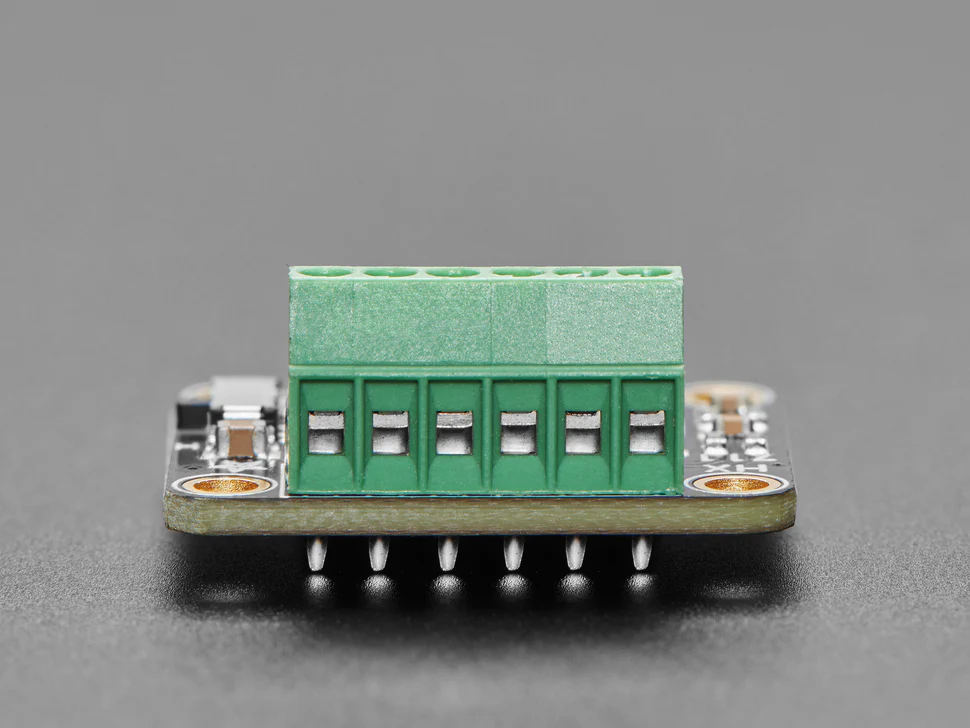
The breakout uses a two-wire protocol (similar to SPI) and comes with pre-soldered 6-port terminal blocks for connecting one or two 4-wire sensors. A slide switch lets you select between 10 SPS and 80 SPS sampling rates. Arduino and CircuitPython libraries are available for quick setup.
Key Features
- 24-Bit Differential ADC – High-resolution readings from Wheatstone bridge sensors
- Dual Channel Input – Channel A with selectable 64× or 128× gain, Channel B with fixed 32× gain
- Pre-Soldered Terminal Blocks – 6-port connector for easy sensor wiring (E+, E-, A+, A-, B+, B-)
- Selectable Sample Rate – Slide switch for 10 SPS or 80 SPS
- Two-Wire Interface – SPI-like protocol for communication with any microcontroller
- Split Analog/Digital Supply – With digital supply filtering for clean readings
- Arduino and CircuitPython Support – Ready-to-use library and example code
Ideal For
- Digital scales and weight measurement
- Load cell and strain gauge applications
- Force and pressure sensing projects
- Industrial measurement and monitoring
Package Contents
- 1× Adafruit HX711 Breakout Board – Assembled with pre-soldered terminal blocks
Resources
Original: $19.28
-70%$19.28
$5.78Product Information
Product Information
Shipping & Returns
Shipping & Returns
Description
The Adafruit HX711 Breakout is a high-resolution 24-bit differential ADC designed for reading load cells, strain gauges, and other Wheatstone bridge sensors. With selectable 64× or 128× gain on Channel A and fixed 32× gain on Channel B, it amplifies the tiny voltage changes from bending or twisting sensors and converts them into precise digital readings for force or mass measurement.
The breakout uses a two-wire protocol (similar to SPI) and comes with pre-soldered 6-port terminal blocks for connecting one or two 4-wire sensors. A slide switch lets you select between 10 SPS and 80 SPS sampling rates. Arduino and CircuitPython libraries are available for quick setup.
Key Features
- 24-Bit Differential ADC – High-resolution readings from Wheatstone bridge sensors
- Dual Channel Input – Channel A with selectable 64× or 128× gain, Channel B with fixed 32× gain
- Pre-Soldered Terminal Blocks – 6-port connector for easy sensor wiring (E+, E-, A+, A-, B+, B-)
- Selectable Sample Rate – Slide switch for 10 SPS or 80 SPS
- Two-Wire Interface – SPI-like protocol for communication with any microcontroller
- Split Analog/Digital Supply – With digital supply filtering for clean readings
- Arduino and CircuitPython Support – Ready-to-use library and example code
Ideal For
- Digital scales and weight measurement
- Load cell and strain gauge applications
- Force and pressure sensing projects
- Industrial measurement and monitoring
Package Contents
- 1× Adafruit HX711 Breakout Board – Assembled with pre-soldered terminal blocks