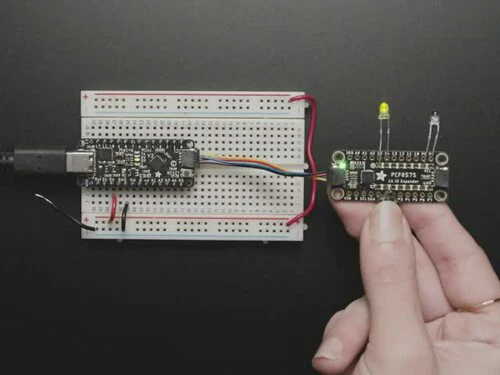
Adafruit PCF8575 I2C 16 GPIO Expander Breakout
The Adafruit PCF8575 GPIO Expander Breakout is an affordable 16-channel I2C GPIO expander that doubles your available digital I/O over a simple two-wire connection. Add extra buttons, LEDs, relays, or other digital peripherals to any microcontroller without using up precious GPIO pins.
Like its 8-channel sibling the PCF8574, the PCF8575 uses an open-drain architecture with no pin direction register. Each pin is either a lightly pulled-up input (100K pull-up, reads high by default) or a strong 20mA ground-sinking output. Arduino and CircuitPython libraries abstract this away, letting you use familiar input/output modes. With three I2C address jumpers, you can chain up to 8 expanders on a single bus for 128 total GPIO.
Key Features
- 16 I/O Pins – Each pin can act as a pulled-up input or a ground-sinking output
- 3 Address Jumpers – Up to 8 expanders on one I2C bus for 128 total GPIO
- IRQ Output – Automatic interrupt alert when any input pin changes value
- Open-Drain Architecture – 100K pull-up inputs and 20mA sink outputs (no direction register)
- STEMMA QT / Qwiic – Solderless STEMMA QT connectors for easy daisy-chaining
- Breadboard Friendly – Standard 0.1″ header pinout with mounting holes
How the Pins Work
- Buttons/Switches – Connect one side to the PCF8575 pin and the other to ground. Pin reads high when open, low when pressed
- LEDs – Connect the LED anode to positive voltage through a resistor. The PCF8575 sinks current to ground to turn the LED on
- Digital I/O – Light pull-up acts as logic high output; strong ground acts as logic low output
Ideal For
- Projects needing many extra buttons, switches, or keypads
- Expanding LED, relay, or indicator control beyond available GPIO
- Multi-expander setups requiring up to 128 digital I/O pins
- Interrupt-driven input change detection across 16 channels
Also Consider
- PCF8574 I2C GPIO Expander – 8-channel version for smaller projects
- MCP23017 I2C GPIO Expander – 16 channels with full input/output direction control
Resources
Product Information
Product Information
Shipping & Returns
Shipping & Returns
Description
The Adafruit PCF8575 GPIO Expander Breakout is an affordable 16-channel I2C GPIO expander that doubles your available digital I/O over a simple two-wire connection. Add extra buttons, LEDs, relays, or other digital peripherals to any microcontroller without using up precious GPIO pins.
Like its 8-channel sibling the PCF8574, the PCF8575 uses an open-drain architecture with no pin direction register. Each pin is either a lightly pulled-up input (100K pull-up, reads high by default) or a strong 20mA ground-sinking output. Arduino and CircuitPython libraries abstract this away, letting you use familiar input/output modes. With three I2C address jumpers, you can chain up to 8 expanders on a single bus for 128 total GPIO.
Key Features
- 16 I/O Pins – Each pin can act as a pulled-up input or a ground-sinking output
- 3 Address Jumpers – Up to 8 expanders on one I2C bus for 128 total GPIO
- IRQ Output – Automatic interrupt alert when any input pin changes value
- Open-Drain Architecture – 100K pull-up inputs and 20mA sink outputs (no direction register)
- STEMMA QT / Qwiic – Solderless STEMMA QT connectors for easy daisy-chaining
- Breadboard Friendly – Standard 0.1″ header pinout with mounting holes
How the Pins Work
- Buttons/Switches – Connect one side to the PCF8575 pin and the other to ground. Pin reads high when open, low when pressed
- LEDs – Connect the LED anode to positive voltage through a resistor. The PCF8575 sinks current to ground to turn the LED on
- Digital I/O – Light pull-up acts as logic high output; strong ground acts as logic low output
Ideal For
- Projects needing many extra buttons, switches, or keypads
- Expanding LED, relay, or indicator control beyond available GPIO
- Multi-expander setups requiring up to 128 digital I/O pins
- Interrupt-driven input change detection across 16 channels
Also Consider
- PCF8574 I2C GPIO Expander – 8-channel version for smaller projects
- MCP23017 I2C GPIO Expander – 16 channels with full input/output direction control