Octopus Analog Photocell Brick OBPhotocell
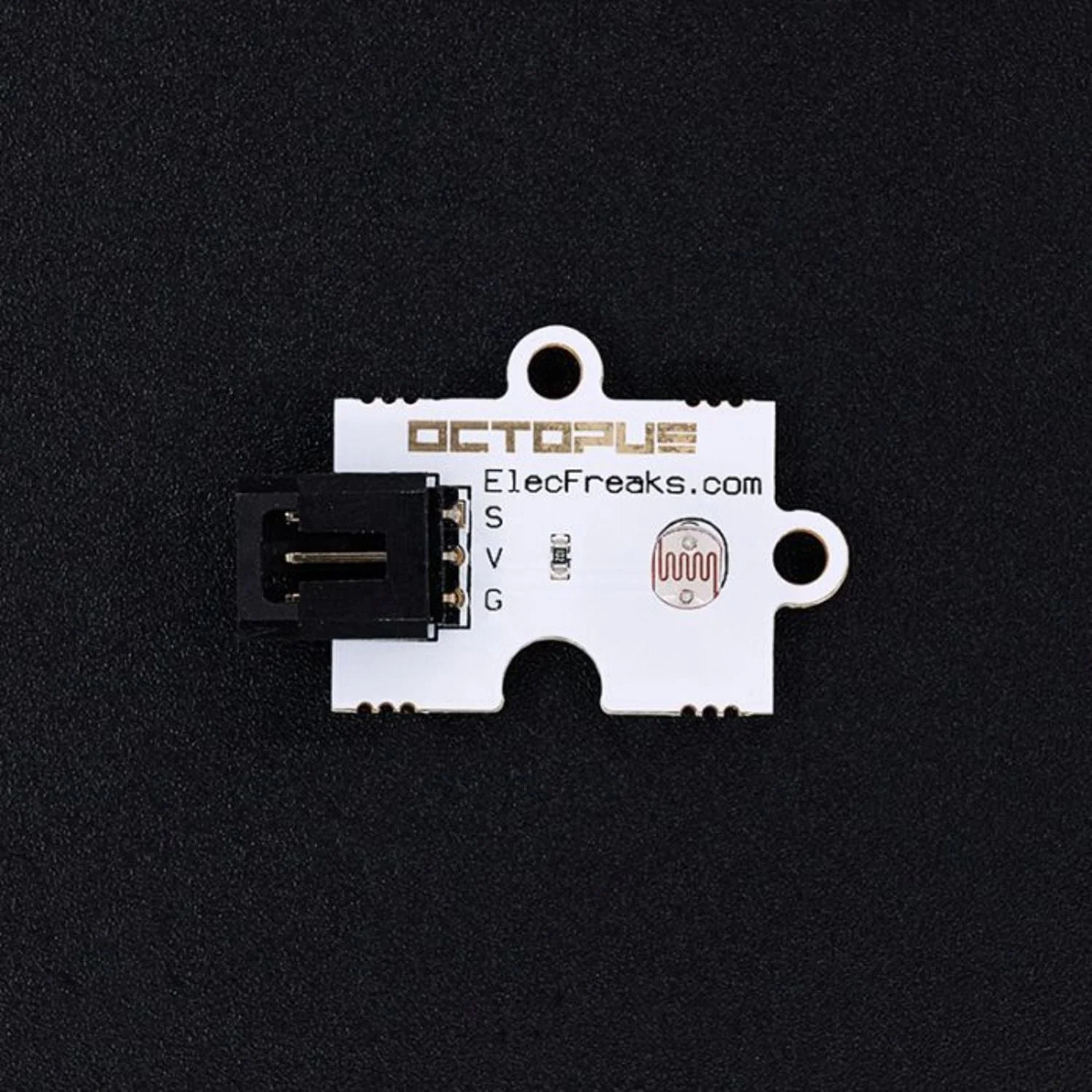
The Octopus Analog Photocell Brick is a light-dependent resistor (LDR) module from the ElecFreaks Octopus Electronic Bricks series. It uses a cadmium-sulfide (CdS) photocell that changes resistance based on ambient light levels — the brighter the light, the lower the resistance. With its 3-pin connector, it plugs directly into sensor shields and expansion boards with no soldering required.
Photocells are ideal for detecting basic light level changes such as "light vs dark", "something blocking a sensor", or "which direction has more light". They're inexpensive and easy to use, though not precise enough for exact lux measurements.
Key Features
- CdS Photocell (LDR) – Resistance varies with light intensity
- Analogue Output – Read light levels via an analogue input pin
- 3-Pin Connector – Buckled wire interface for secure, breadboard-free connections
- Plug and Play – No soldering; connects directly to sensor shields and OCTOPUS:BIT
- Wide Compatibility – Works with Arduino, micro:bit (via OCTOPUS:BIT), and other MCU boards
Ideal For
- Light vs dark detection for automated projects
- Break-beam and object detection sensors
- Ambient light level monitoring
- Beginner Arduino and micro:bit projects
- STEM education and classroom activities
Resources
Product Information
Product Information
Shipping & Returns
Shipping & Returns
Description
The Octopus Analog Photocell Brick is a light-dependent resistor (LDR) module from the ElecFreaks Octopus Electronic Bricks series. It uses a cadmium-sulfide (CdS) photocell that changes resistance based on ambient light levels — the brighter the light, the lower the resistance. With its 3-pin connector, it plugs directly into sensor shields and expansion boards with no soldering required.
Photocells are ideal for detecting basic light level changes such as "light vs dark", "something blocking a sensor", or "which direction has more light". They're inexpensive and easy to use, though not precise enough for exact lux measurements.
Key Features
- CdS Photocell (LDR) – Resistance varies with light intensity
- Analogue Output – Read light levels via an analogue input pin
- 3-Pin Connector – Buckled wire interface for secure, breadboard-free connections
- Plug and Play – No soldering; connects directly to sensor shields and OCTOPUS:BIT
- Wide Compatibility – Works with Arduino, micro:bit (via OCTOPUS:BIT), and other MCU boards
Ideal For
- Light vs dark detection for automated projects
- Break-beam and object detection sensors
- Ambient light level monitoring
- Beginner Arduino and micro:bit projects
- STEM education and classroom activities