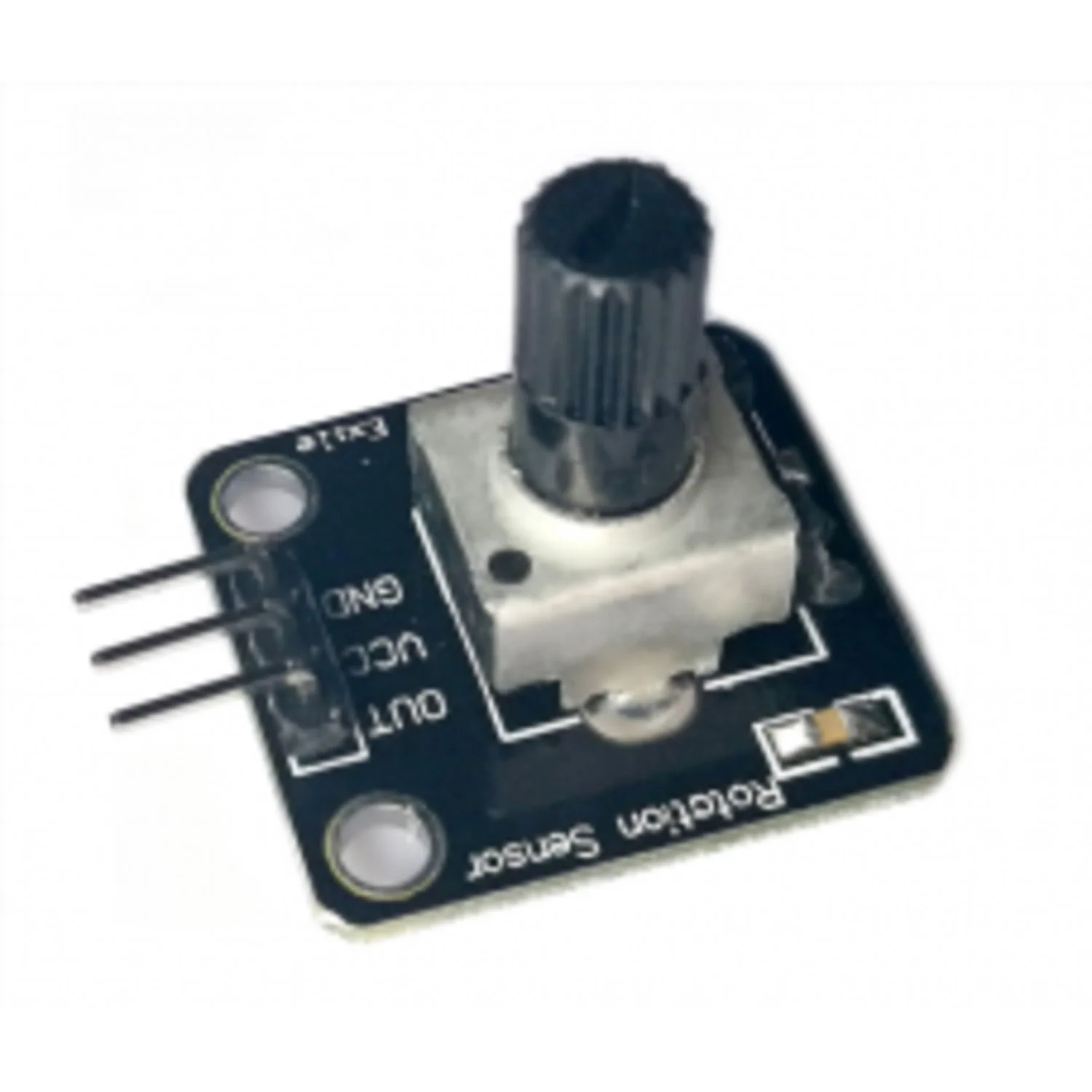
Potentiometer Module
This Potentiometer Module is from our Micro:bit 24 bit kit.
You're probably already familiar with using a potentiometer as they are commonly found on many electrical devices, such as in audio equipment where they are used for volume control. After all, potentiometers are sensors! What's a sensor? Simply put, a sensor is a device that receives and responds to a signal.
- Potentiometers are analog input sensors.
- While digital sensors deal with values that are either ‘1’ or ‘0’, analog sensor values are continuous.
- Analog sensors are able to tell us not just whether it senses something, but also how much of that something it senses.
- In the case of the potentiometer, it measures electric potential, also known as voltage.
- It has three pins.
- Two terminals (labelled 'A' and 'B' in the diagram) are connected to a resistive material, while a third terminal is connected to an adjustable wiper (labelled 'W' in the diagram).
- The resistance between the two outer terminals is fixed; it is the maximum resistance of the potentiometer.
- The resistance between the middle terminal and either one of the outer terminals ranges from 0 Ω to the maximum resistance of the potentiometer as the knob is moved.
20K Ohm Rotary Potentiometer Module
Product Information
Product Information
Shipping & Returns
Shipping & Returns
Description
This Potentiometer Module is from our Micro:bit 24 bit kit.
You're probably already familiar with using a potentiometer as they are commonly found on many electrical devices, such as in audio equipment where they are used for volume control. After all, potentiometers are sensors! What's a sensor? Simply put, a sensor is a device that receives and responds to a signal.
- Potentiometers are analog input sensors.
- While digital sensors deal with values that are either ‘1’ or ‘0’, analog sensor values are continuous.
- Analog sensors are able to tell us not just whether it senses something, but also how much of that something it senses.
- In the case of the potentiometer, it measures electric potential, also known as voltage.
- It has three pins.
- Two terminals (labelled 'A' and 'B' in the diagram) are connected to a resistive material, while a third terminal is connected to an adjustable wiper (labelled 'W' in the diagram).
- The resistance between the two outer terminals is fixed; it is the maximum resistance of the potentiometer.
- The resistance between the middle terminal and either one of the outer terminals ranges from 0 Ω to the maximum resistance of the potentiometer as the knob is moved.
20K Ohm Rotary Potentiometer Module